Open the interactive black hole →
The first EHT image of M87* contains a bright ring and a dark center. Making sense of it requires two pieces of engineering: a model of how light reaches an observer near a black hole, and a method for recovering an image from measurements spread across a planet-sized telescope array.
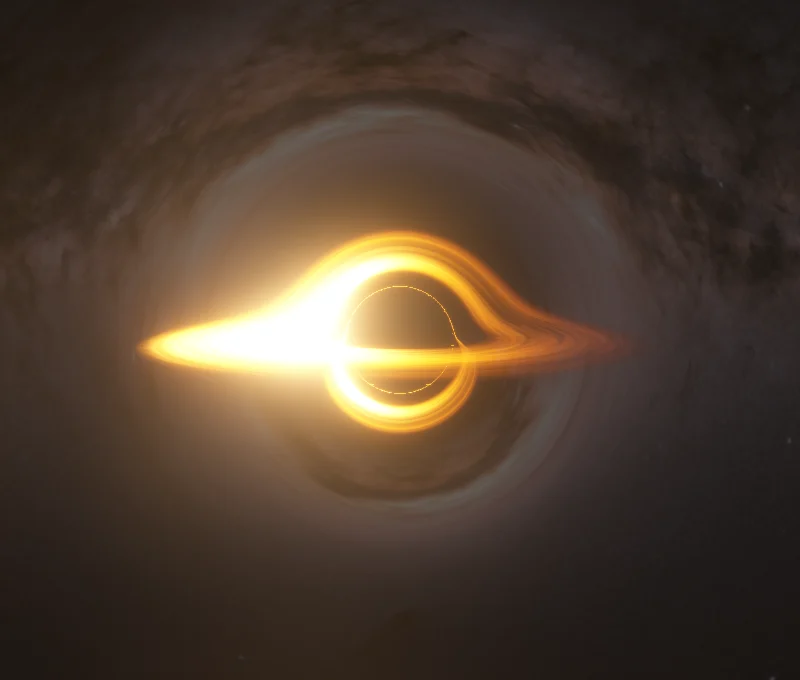
The interactive study uses Eric Bruneton’s WebGL renderer to explore the first piece. It traces light around a non-rotating black hole with an accretion disk and background stars. Changing the viewpoint makes the curved light paths much easier to understand than a single image does.
Three different radii #
A Schwarzschild black hole has an event-horizon radius
The horizon is the boundary beyond which light cannot escape to a distant observer. The unstable circular photon orbit sits farther out, at , or .
The apparent shadow has another scale. For a distant observer in Schwarzschild geometry, the critical impact parameter is
An impact parameter describes the offset of an incoming light ray far from the black hole. It is not a physical surface. The dark region in an image is enlarged by the paths light can take through curved spacetime; measuring its diameter as though it were the event horizon would give the wrong answer.
Emission from the surrounding plasma adds another layer. The width and brightness of the observed ring depend on where the emitting material sits, how it moves and how its radiation propagates.
Why the disk appears above itself #
In flat space, a thin disk viewed nearly edge-on looks like a narrow strip. Near a black hole, rays from the far side can bend over and under the central shadow. The observer receives multiple images of the same disk.
Start with a stationary observer in the demo and inspect the bright arc above the shadow. That arc is a lensed view of disk material behind the black hole. Change the camera angle and watch it move relative to the direct image. The disk has not physically bent into that shape; its image has.
Brightness also carries information. Material moving toward the observer can appear brighter through relativistic Doppler effects and beaming. Gravitational redshift changes the radiation as it climbs out of the gravitational field. The renderer exposes lensing and Doppler controls, which make it possible to examine their contributions separately.
Making curved light paths run in a browser #
Bruneton’s renderer and technical documentation describe a beam-tracing method built around precomputed lookup tables. The tables let the shader find intersections between a light beam and the scene in constant time per pixel, instead of repeatedly integrating a full geodesic for every pixel on every frame.
That choice moves expensive work out of the rendering loop. It also makes the model’s assumptions valuable: the symmetry of a non-rotating black hole allows a compact, reusable description of the ray geometry.
Stars need special treatment. A point source can become strongly magnified near the critical curve, and ordinary texture sampling can make it flicker or disappear. The implementation uses custom filtering for the star field and accounts for lensing amplification across a pixel’s footprint.
The demo is a locally hosted adaptation of Bruneton’s implementation, under BSD-3-Clause. Launching it loads the renderer and its datasets; stopping it removes the embedded document. The page itself starts with a static image.
What the EHT actually measured #
On April 10, 2019, the Event Horizon Telescope Collaboration released its first image of M87*. The collaboration’s announcement through ESO describes a black hole about 55 million light-years away, with a mass of roughly 6.5 billion Suns.
Eight telescopes contributed to the array used for the observations. Very-long-baseline interferometry at a wavelength of 1.3 mm linked them into a telescope with baselines comparable to Earth’s diameter, reaching an angular resolution of about 20 microarcseconds.
An interferometer samples spatial-frequency information about the sky. It does not collect a complete camera frame. The EHT team had to calibrate the measurements and reconstruct an image from sparse coverage, checking the result with independent analysis and imaging pipelines.
The distinction from the demo is operational. A renderer starts with a spacetime, an emitting scene and an observer, then predicts an image. EHT imaging starts with telescope measurements and estimates a sky image consistent with them. Physical models can then be compared with those measurements and reconstructions.
Use the model for the geometry #
Bruneton’s Schwarzschild disk is a useful way to study the shadow, lensing and observer motion. Interpreting M87* also involves hot plasma, magnetic fields and possible black-hole spin. The demo’s scene parameters are not a fit to the EHT data.
Watch the far-side disk arc as you change the view, then compare lensing and Doppler settings. The features that persist explain why a dark central region and surrounding emission are such a powerful observational signature. Connecting a particular image to the mass and environment of M87* requires the measurement and modeling work of the collaboration.
Sources #
- Event Horizon Telescope Collaboration / ESO, Astronomers Capture First Image of a Black Hole, April 10, 2019.
- Eric Bruneton, A Real-time High-quality Black Hole Shader, method and implementation notes.
- Eric Bruneton, Source code and license.